





BLOGSDETAILS
Carbon Fiber Lure Rod for Bass Fishing: Spinning vs Baitcasting Guide
Author:cangfeng Time:2026-09-24 16:20:52 Click:144
A carbon fiber lure rod is one of the most consequential pieces of tackle a bass angler will ever buy. It dictates how a lure loads on the cast, how much feedback reaches your hand, how cleanly a hookset transfers energy to the fish, and how quickly you can detect a subtle take in deep cover. Whether you run a tackle shop, stock a distribution catalogue, or simply want to understand the engineering behind the rods you sell, this guide breaks down what carbon fiber brings to bass fishing, how spinning and baitcasting platforms differ, and how to match a carbon fishing rod to the techniques you actually fish.
What Carbon Fiber Lure Rods Are and Why They Matter
Carbon fiber, more precisely carbon-fiber-reinforced polymer (CFRP), is a composite built from thin carbon filaments bound in a resin matrix. The fibers carry the load; the resin holds them in alignment and protects them. Because carbon filaments are both stiff and light, a blank built from them can be made thinner and lighter than a comparable fiberglass blank while resisting deformation under load.
In practical bass-fishing terms, that translates into several advantages:
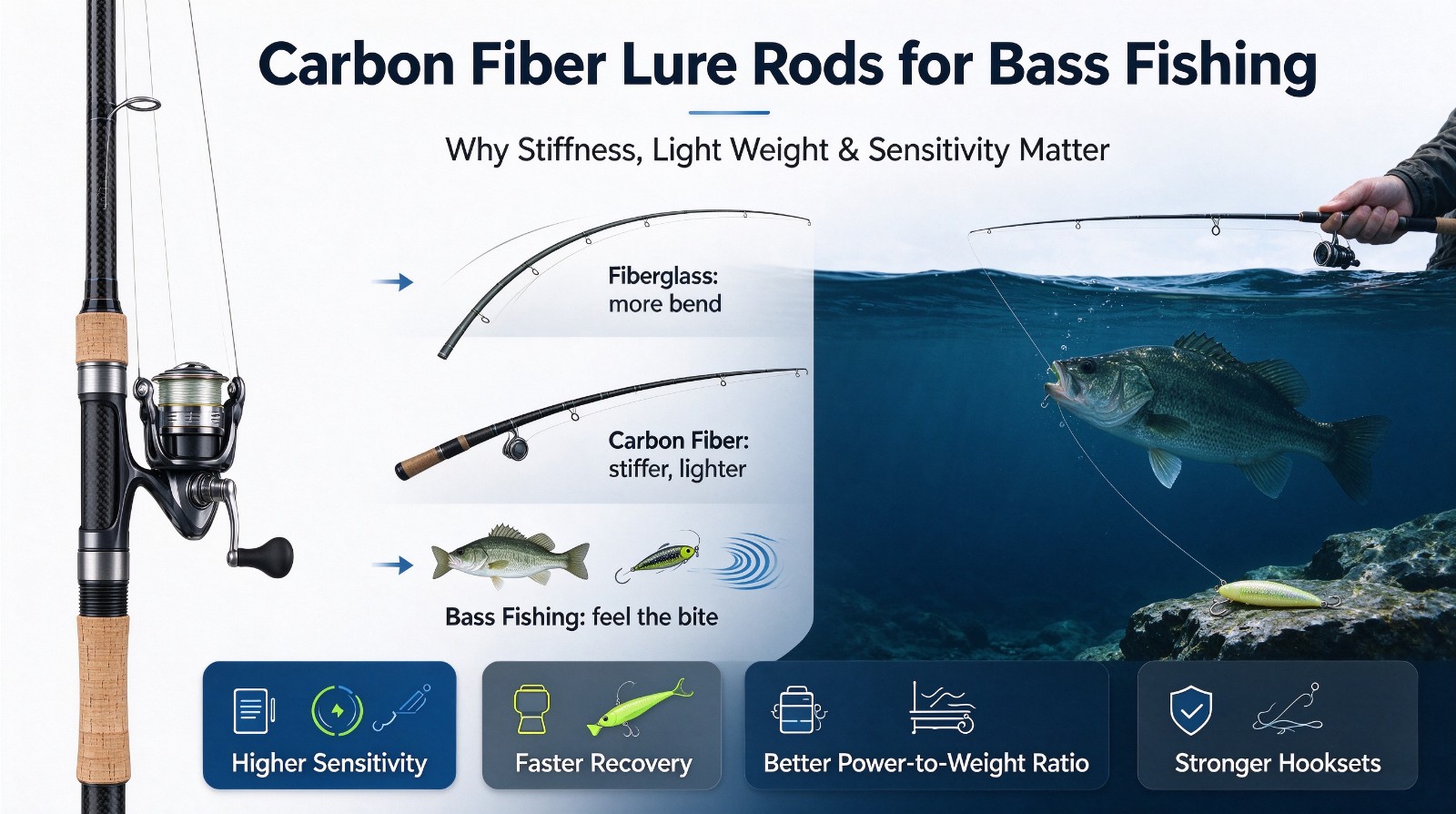
Higher sensitivity. A stiff, low-mass blank transmits vibration and feel from the lure to the angler's hand more directly — critical when dragging a soft plastic across rock or detecting a soft "tick" on a jig.
Faster recovery. CFRP blanks return to rest faster after the cast, reducing blank wobble and improving accuracy.
Better power-to-weight ratio. A lighter rod reduces fatigue during a long day of casting, which matters for anyone fishing competitively or from a kayak.
Strong hooksets. The stiffness of carbon lets the angler move the hook point with less deflection energy lost in the blank.
For a species like largemouth and smallmouth bass — which demand both finesse and brute force depending on the technique — that combination of sensitivity and authority is why carbon fiber has become the default choice for serious lure fishing equipment.
Rod Action Explained: Fast, Moderate, Extra Fast
"Action" describes where a rod blank bends under load, and it is arguably the single most misunderstood specification in rod selection. It is separate from "power," which describes how much load the blank can bear before it bottoms out.
Extra-fast action. The blank bends mostly in the top third. This delivers the fastest tip recovery and the most direct hooksets, and it is favoured for single-hook lures where a crisp, immediate hookset is essential — jigs, Texas-rigged plastics, and most soft-plastic presentations.
Fast action. The blank bends in the upper half. It balances sensitivity with a little more cushion, making it the most versatile choice for a fast action fishing rod used across multiple techniques. It is a strong default for a bass angler who wants one rod to do a lot.
Moderate / moderate-fast action. The blank bends deeper into the middle. The slower, more parabolic curve keeps treble-hook lures loaded and prevents hooks from tearing out during a head-shake. This is the classic profile for crankbaits and other moving baits.
A bass fishing rod is rarely "best" in the abstract — it is best for a specific job. Matching action to lure type is the fastest way to improve hookup ratios.
Spinning vs Baitcasting for Bass Fishing
Both a spinning lure rod and a baitcasting lure rod can catch bass in the same water on the same day. The distinction is about control, lure weight, and casting mechanics.
Spinning Rods
A spinning rod carries the reel beneath the blank, with line peeling off a fixed spool. Its advantages:
Handles light lures and light line exceptionally well, making it the natural platform for finesse presentations.
Easy to cast for anglers of all skill levels — backlash is not a factor.
Excellent for skipping lightweight plastics under docks and overhangs.
Spinning rods shine with drop-shots, shaky heads, small soft plastics, and weightless presentations where a baitcasting reel would struggle to manage a very light payload.
Baitcasting Rods
A baitcasting rod carries the reel on top of the blank, with line released from a rotating spool the angler controls with their thumb. Its advantages:
Superior casting accuracy and the ability to "feather" a lure into a precise target.
Better leverage for heavy lures and heavy cover, so it is the standard for flipping, pitching, and punching.
Greater line capacity and drag authority for big fish around structure.
Baitcasting setups dominate power-fishing techniques: jigs, big swimbaits, heavy Texas rigs, and flipping into thick vegetation. The tradeoff is a steeper learning curve and less forgiveness with very light lures.
For a distributor, the practical takeaway is that these two platforms are complementary, not competing. A well-rounded bass angler — and a well-rounded tackle range — covers both.
Carbon Fiber Grade: What IM6, IM7, and IM8 Mean
You will often see blanks described as IM6, IM7, or IM8. The "IM" convention refers to intermediate modulus carbon, a family of fibers offering higher stiffness than standard-modulus carbon while remaining more forgiving and cost-effective than high-modulus grades.
IM6. The baseline intermediate-modulus fiber, generally the most affordable and most durable of the group. Blanks are a little heavier and less crisp but forgiving.
IM7. A step up in stiffness, giving lighter, more sensitive blanks with faster recovery. This is a common sweet spot for value-focused performance rods.
IM8. Higher modulus still, producing the stiffest, lightest, most sensitive blanks in this family. These are premium blanks that reward good technique but can feel brittle if abused.
Two important caveats. First, a higher number is not automatically better for every angler or every technique. A moderate-action IM7 rod will outperform an extra-fast IM8 rod in applications that benefit from deeper loading, such as fishing certain crankbaits or handling treble-hook lures. Second, modulus ratings describe the fiber type, not the complete rod's performance. A well-designed IM6 rod built with a thoughtful layup schedule can outperform a poorly made IM8 rod in the field. B2B buyers should evaluate complete blank performance rather than fiber grade alone.
Key Specifications to Evaluate
Power Rating
Power describes how much load is required to bend the rod. For bass fishing, medium to medium-heavy power is the most commonly used range, capable of handling lures from 1/4 oz up to 1 oz or more with appropriate line. Ultralight power is reserved for finesse and trout applications; heavy and extra-heavy power are used for flipping, punching, and heavy saltwater applications.
Lure Weight Range
The lure weight range tells you whether the rod will load correctly with a given lure. A lure that is too light will not load the rod enough for a clean cast; a lure that is too heavy will overload and potentially damage the blank. Check that the lure weights you fish most frequently fall within the rod's recommended range.
Line Rating
Line rating indicates the breaking strength the rod is designed to manage. Matching line weight to the rod's rating ensures the rod can handle the load of a cast and a fish fight without being over- or under-matched. Line ratings typically cover a range, such as 10–20 lb, and you should stay within that range for best performance.
Guide Quality
Guides route line from the lure to the reel. On a freshwater fishing rod, stainless steel frames with ceramic or Alconite inserts provide a good balance of durability and line flow. On baitcasting rods, the guide train is mounted on top of the blank, and the first guide (foot) must be positioned precisely to align with the reel's spool. On spinning rods, guides are on the underside and the foot guide must align with the reel's line roller. Mismatched alignment causes line wear and casting problems.
Handle Material and Design
Handles are typically made from cork, EVA foam, or a composite. Cork is traditional and provides good vibration transmission. EVA foam is more durable, easier to clean, and maintains grip in wet or cold conditions. Handle length affects leverage: longer handles provide more cranking power for big fish; shorter handles offer better maneuverability in tight spaces.
Matching a Rod to Bass Techniques
Topwater and Frog Fishing
These techniques demand immediate hook-setting authority and the ability to sweep a single hook free from a frog's body. A medium-heavy to heavy-power, fast-action rod with a strong butt section is the standard choice. The rod must have enough backbone to set the hook through a frog's plastic body and into a bass's mouth in a single motion.
Jigs and Heavy Soft Plastics
Jig fishing around rocks, wood, and ledges calls for a medium-heavy to heavy-power, fast or extra-fast action rod. Sensitivity matters for detecting the subtle "tick" of a jig bumping bottom, and a stiff backbone is needed to drive the hook through a bass's tough mouth.
Crankbaits
Crankbait fishing benefits from a moderate-action rod that absorbs the shock of treble hooks setting during head shakes. A moderate-fast or moderate rod in medium or medium-heavy power keeps treble hooks pinned without tearing them free. The deeper flex also protects light trebles from being pulled out on hard-charging fish.
Finesse Presentations
When bass are negative or in highly pressured water, a bass spinning rod in medium-light or medium power with fast action handles drop-shots, shaky heads, and Ned rigs effectively. The spinning reel allows casting very light lures accurately, and the sensitive tip detects bites that a heavier rod would miss.
Freshwater-Specific Considerations
Freshwater bass fishing covers a wide range of environments — clear spring-fed lakes, stained farm ponds, swift tailraces, and weed-choked rivers. Each environment has distinct demands:
Clear water: Use lighter line, longer rods for distance, and more finesse-oriented presentations. Fluorocarbon line becomes more valuable.
Stained or colored water: Heavier line and more aggressive presentations become viable. Braided line with a fluorocarbon leader is effective.
Heavy cover: The rod must have enough backbone for flipping and pitching, and the guides must handle braid without chafing.
Current: A longer rod helps manage line in the current, and a moderate action helps absorb the shock of a fish fighting current while you manage the drift.
Maintenance Basics
Carbon fiber rods are durable when maintained properly. Rinse the rod with fresh water after use, particularly after exposure to saltwater or mineralized water. Inspect guides before each outing for loose frames, cracked inserts, or alignment issues. Check the reel seat periodically to ensure the hoods grip securely and do not allow the reel to shift during use. Store rods horizontally or in padded cases, never resting on the tip, and avoid prolonged exposure to direct sunlight or extreme heat.
Conclusion
The carbon fiber lure rod is the foundation of effective bass fishing, and choosing the right one requires understanding how carbon fiber construction, rod action, and power rating interact with your chosen techniques. Spinning rods provide unmatched versatility for light-lure presentations and accessibility for newer anglers. Baitcasting rods deliver precision and power for heavy cover and aggressive techniques. Both platforms benefit from carbon fiber's sensitivity, light weight, and fast recovery. Matching those attributes to the specific demands of your primary techniques — rather than buying on brand or price alone — is what separates a well-chosen rod from an expensive one.
For B2B buyers sourcing bass lure gear, stocking a range that covers both spinning and baitcasting categories, across multiple power and action ratings, ensures you can serve the full spectrum of bass fishing customer needs without gaps in your offering.
FAQ
What is the best rod action for bass fishing?
There is no single best action for all bass fishing. Fast-action rods are the most versatile, handling jigs, soft plastics, jerkbaits, and many topwater presentations with authority. Extra-fast action provides maximum sensitivity and hooksets, ideal for single-hook lures in heavy cover. Moderate action suits crankbait fishing and situations where a more forgiving blank reduces treble-hook pullouts. Most bass anglers own multiple rods to cover different techniques rather than relying on one all-purpose rod.
Should a beginner start with a spinning or baitcasting rod?
A spinning rod is generally easier for beginners to learn with. The fixed-spool reel eliminates backlashes, making it more forgiving as the caster develops their technique. Spinning rods are also the platform of choice for the finesse presentations that often produce bites when a beginner is still mastering casting accuracy. Once the fundamentals of casting and fish handling are established, a baitcasting rod can be added to cover heavier lure applications.
Is a higher carbon fiber modulus always better?
Not necessarily. Higher-modulus carbon (IM8, T800) produces lighter, stiffer, more sensitive blanks, but these benefits come with reduced forgiveness and greater brittleness. An IM7 rod with a thoughtful layup is often more durable and more pleasant to fish with than an IM8 rod built to a lower price point. For most bass fishing applications, IM7 provides an effective balance of sensitivity, weight, and toughness.
What line should I use with a carbon fiber bass rod?
The choice depends on the technique and water conditions. For finesse spinning with light lures, 6–10 lb fluorocarbon provides invisibility and sensitivity. For flipping and pitching heavy cover, 40–65 lb braided line with a leader is standard for its no-stretch power and cut-resistance. For general casting with crankbaits and spinnerbaits, 12–20 lb monofilament absorbs shock and handles the dynamics of treble-hook lures well.
How long should a bass fishing rod be?
The most common bass rod lengths fall between 6'6" and 7'6". A 6'6" to 7' rod is the versatile sweet spot for most bank and boat applications. Longer rods (7'6" and above) extend casting distance and provide more leverage for long-distance hooksets but can be harder to manage in heavy cover. Shorter rods (6' to 6'6") are more accurate in close quarters but sacrifice casting distance and leverage.
References
Lee, C.K. and Singh, M. (2004). "Analysis of fishing rod design using composite materials." Sports Engineering, Vol. 7, No. 4, pp. 201–211. DOI: 10.1007/s10270-004-0056-1.
American Sportfishing Association. (2025). State of the Industry Report: Fishing Equipment Trends and Market Analysis. American Sportfishing Association, Alexandria, VA.
International Organization for Standardization. (2018). ISO 7542:2018 — Fishing Equipment — Fishing Rods — Safety Requirements and Test Methods. ISO, Geneva.
Schmidt, D.L. (2019). "Fluorocarbon vs. monofilament fishing line: Comparative performance in freshwater applications." North American Journal of Fisheries Management, Vol. 39, No. 3, pp. 512–528.
Browse the full selection of carbon fiber lure rods at Cangfeng designed for bass fishing and all freshwater predator applications.
 HOT PRODUCT
 CONTACT US